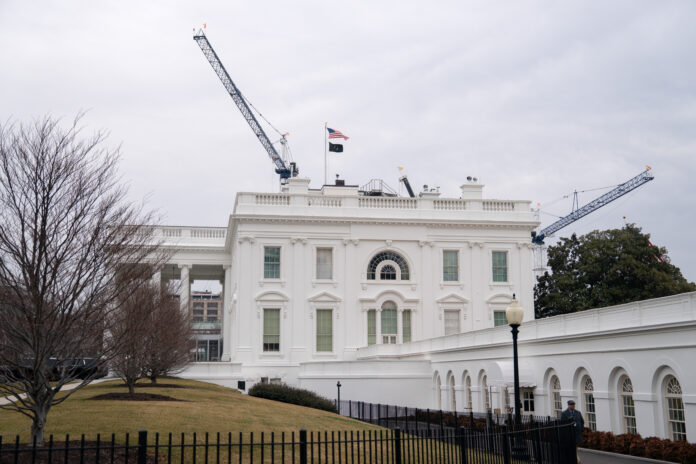
President Donald Trump scored a significant legal victory Friday as the Supreme Court allowed construction of his massive new White House ballroom to continue while litigation over the project moves forward, lifting for now a lower-court restriction that had blocked portions of the work.
The ballroom, being constructed on the site of the demolished East Wing, is expected to span approximately 90,000 square feet — roughly twice the size of the main portion of the White House complex. Although Trump had repeatedly said taxpayers would not be responsible for the project, its cost has reportedly climbed to at least $300 million, with some public funding now expected to be involved.
Friday’s Supreme Court action marked the latest development in a months-long legal fight between the Trump administration and the National Trust for Historic Preservation. The nonprofit sued in an effort to stop the project, contending that Trump cannot undertake construction of this magnitude on the East Wing site without first obtaining authorization from Congress.
The ballroom would dramatically expand the White House’s capacity for large-scale official functions, addressing what Trump has long complained is inadequate space for major events, particularly state dinners and gatherings involving foreign leaders.
Trump has also maintained that the project goes far beyond entertaining guests. He has said the new complex will incorporate major national-security infrastructure, including bomb shelters, medical facilities, sniper positions and a drone port.
The Supreme Court became involved after a series of conflicting lower-court decisions left the future of the construction uncertain. The justices faced a Friday deadline to act on the administration’s emergency request.
In a brief order signed by Chief Justice John Roberts, the Supreme Court stayed the lower-court ruling that had halted portions of the construction, clearing the way for work to proceed while the underlying legal dispute continues.
The National Trust for Historic Preservation warned the justices earlier this week that allowing the administration to continue building could effectively render its lawsuit meaningless because so much of the project could be completed before courts reach a final decision.
“Rather than obtain permission from Congress, Petitioners have instead decided to try to outrun judicial review” by accelerating construction, the organization wrote. “It is clear that in Petitioners’ view, if the Court grants their stay application, this case is over—despite every court to have reviewed their project having found it to be patently unlawful, and no matter the fact that this Court has not reviewed those decisions on the merits.”
The legal battle began in March, when U.S. District Judge Richard Leon ruled against the Trump administration and ordered construction stopped except for portions of the project related to White House safety and security.
The administration appealed to the U.S. Court of Appeals for the D.C. Circuit, which subsequently permitted construction to continue temporarily. Leon later refined his order, allowing underground work on the ballroom complex to move ahead while continuing to prohibit above-ground construction.
Trump sharply objected to the distinction, arguing that the security components and ballroom construction could not realistically be separated.
“It’s all tied together as one big, expensive, and very complex unit, which is vital for National Security and Military Operations of the United States of America!” Trump wrote on social media.
The dispute returned to the appeals court, but the Trump administration ultimately sought emergency intervention from the Supreme Court, asking the justices to allow the entire project to move forward while the litigation continues.
Construction began last July and has already significantly altered the area surrounding the White House. Access to portions of the north side of the White House grounds and Lafayette Park, areas previously accessible to the public, has been restricted as work has progressed.
The project has also generated considerable public opposition. An April Washington Post-ABC News-Ipsos poll found that 56% of Americans disapproved of Trump’s decision to demolish the East Wing and construct the ballroom.
Friday’s Supreme Court order does not resolve the central legal question of whether Trump ultimately has the authority to complete the ballroom without congressional approval. Instead, it allows construction to proceed while the courts continue considering the case.
For Trump, however, the immediate effect is clear: work on one of the most ambitious physical transformations of the White House in modern history can continue.
{Matzav.com}