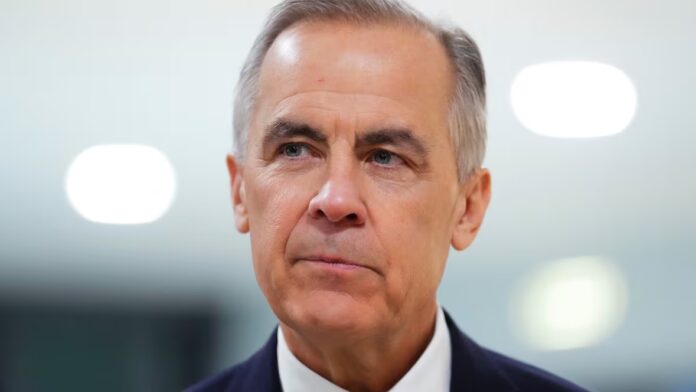
Canada announced Saturday that it will impose retaliatory tariffs against the United States beginning Sept. 8, escalating a rapidly widening trade confrontation after President Donald Trump’s 50% tariffs on approximately $20 billion in Canadian goods took effect and last-minute negotiations between the longtime allies collapsed.
Canadian Prime Minister Mark Carney said Ottawa will release specifics of the retaliatory package shortly, with the new duties targeting a broad range of American products.
“in the coming days, we will release the details of these new tariff measures, which will come into force the Tuesday after Labor Day.”
Canada plans to retaliate on a dollar-for-dollar basis, with steel, dairy products, appliances, agricultural equipment, pulp and paper, and electronics among the sectors expected to be targeted.
Carney revealed that during negotiations, Canada had offered to eliminate its remaining retaliatory tariffs on American steel, aluminum and automobiles if Washington substantially reduced its own tariffs. Ottawa was also prepared to encourage Canadian provinces to resume sales of US alcohol.
The prime minister said the final terms sought by Washington were ultimately unacceptable.
“They asked too much and offered too little.”
The deepening dispute is also raising new questions about the future of the broader North American trade framework linking the United States, Canada and Mexico, an agreement upon which major industries in all three countries heavily depend.
Canada had entered the negotiations seeking tariff relief for several key industries, including steel, aluminum, automobiles and lumber.
US Trade Representative Jamieson Greer placed responsibility for the failed negotiations on Ottawa, arguing that Canadian officials retreated from commitments made earlier in the week.
“Tonight, Canada declined to finalize the trade deal under the terms agreed earlier this week. Despite the U.S. offer to Canada to receive the best treatment of any major exporter to our market, new demands and walk-backs of other commitments by Canada have upended the careful balance reached in the past days,” Greer said in a statement read to reporters shortly before midnight.
Carney offered a sharply different account of why negotiations failed, accusing the Trump administration of changing its demands as the deadline approached.
“last-minute changes in the U.S. proposed terms were unfair, uneconomic, and called into question the reliability of any deal.”
The Canadian leader said his government will also unveil additional measures in the coming days aimed at assisting Canadian businesses and workers affected by the expanding trade battle.
Greer characterized Washington’s proposal as “forward-looking” and said it offered “a historic economic and national security partnership.”
For now, there are no additional negotiations scheduled between the two governments.
The collapse represented a dramatic turnaround from the optimism expressed only two days earlier, when officials on both sides indicated that Washington and Ottawa appeared to be moving toward an agreement.
Carney said Canada had always sought the strongest possible arrangement for the country, “never a deal at any price or on any deadline.”
Ontario Premier Doug Ford threw his support behind Carney’s decision to retaliate. Ford said the prime minister has his “full support” for a response conducted “tariff for tariff, dollar for dollar” and insisted that “everything needs to be on the table.”
The economic stakes are enormous. The United States and Canada exchanged approximately $880 billion in goods and services last year, making their bilateral commercial relationship one of the largest in the world.
Trump’s tariffs had initially been scheduled to take effect at 12:01 a.m. Wednesday. The president extended the deadline by three days as negotiations intensified, but officials ultimately failed to reach an agreement before the new deadline expired.
Trade disputes between Washington and Ottawa are hardly new. The neighboring countries have sparred for decades over issues ranging from Canadian softwood lumber to American access to Canada’s tightly controlled dairy market.
Despite those recurring disagreements, the two countries traditionally maintained an unusually close economic, military and diplomatic relationship. Canadian troops fought alongside American forces in Afghanistan following the Sept. 11 attacks, while the 5,525-mile US-Canada border has remained undefended. Nearly 330,000 people and approximately $2 billion in goods cross the border every day, while roughly 800,000 Canadians reside in the United States.
Trump’s treatment of Canada has represented a significant break from that traditionally cooperative relationship. The president has used tariffs as part of his effort to shift manufacturing back to the United States and has repeatedly generated controversy in Canada by suggesting that the country could become America’s 51st state.
Carney said his government has come to recognize that “America has changed” and that Canada and the United States would “not return to our old relationship.”
Anti-American sentiment has also grown among some Canadians. A petition calling for the expulsion of US Ambassador Pete Hoekstra, a Trump ally, has attracted nearly 248,000 signatures since July 21. Organizers have accused Hoekstra of having “normalized” Trump’s comments about annexing Canada, among other complaints.
Both governments nevertheless faced significant incentives to avoid an escalating tariff war.
Almost 72% of Canadian goods exports went to the United States last year, making access to the American market critical to Canada’s economy. At the same time, the Trump administration faces the possibility that additional tariffs — which are paid initially by American importers and can ultimately be passed on to consumers — could increase prices ahead of November’s midterm elections, when the cost of living remains a major concern for voters.
“Canada likely wanted further sector-specific relief than the U.S. was willing to offer, or Canada’s concessions did not go far enough,” said Ryan Majerus, a partner at King & Spalding and a former U.S. trade official. “Either way, I think both sides will be under immense pressure in the coming days to still find an off-ramp. But if Canada has agreed to also impose tariffs, the off-ramp may be even harder to find.”
Candace Laing, president and CEO of the Canadian Chamber of Commerce, described the new tariffs as “a body blow to North American competitiveness” and warned that the escalating dispute could increase costs for American consumers while hurting Canadian customers, investment and small businesses.
{Matzav.com}