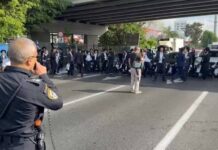
Preparations for the massive annual Rosh Hashanah gathering in Uman are accelerating, with approximately 2,000 visitors already in the Ukrainian city and tens of thousands more expected in the coming days despite the continuing war. This year’s travelers face a series of additional complications, including problems at a major Polish-Ukrainian border crossing, new European biometric requirements and strict security restrictions in Uman.
According to figures released by the United Jewish Community of Ukraine, approximately 2,000 people have already arrived in Uman and begun preparing for Yom Tov. Organizers expect the total number of visitors to reach approximately 40,000, with participants planning to spend Rosh Hashanah near the kever of Rav Nachman of Breslov despite the ongoing fighting in Ukraine.
Polish authorities, meanwhile, have issued an urgent advisory urging travelers heading to Uman to avoid the Medyka-Shehyni border crossing whenever possible. Extensive infrastructure work currently underway at the crossing has sharply reduced its capacity to accommodate buses, raising concerns about delays lasting many hours and potentially severe congestion. Organizers and travelers are being advised to use alternative crossings, including Korczowa and Budomierz.
Romania is also undertaking extensive preparations for the influx of travelers expected to pass through the country on their way to Ukraine. A large coordination meeting was held Wednesday involving senior Romanian government officials, local police and security agencies, border police, representatives of Israel’s Foreign Ministry and representatives of the Breslov Union in Uman, led by Rav Nosson Ben Nun.
The meeting focused heavily on security arrangements for the journey. Romanian officials reviewed a special operational protocol prepared by representatives of the Breslov Union at the government’s request. Plans include advanced measures to monitor and secure the movement of travelers to and from Uman, along with interpreters, assistance personnel at border crossings and designated rest areas for those making the lengthy trip.
Romania’s Border Police announced that it will substantially increase staffing at multiple crossings in addition to the resources being provided by the Breslov Union along the country’s land border with Ukraine. The additional personnel are intended to speed up processing and reduce the lengthy waits that can develop between Romania and Ukraine. Representatives of the Breslov Union thanked the Romanian government for its cooperation and extensive preparations and agreed to publicize official government instructions to travelers as they are issued.
Another potential source of delays this year is the European Union’s new Entry/Exit System, known as EES, which travelers entering or leaving through EU countries will have to take into account. The computerized system replaces traditional manual passport stamping with an automated digital record of border crossings.
For travelers who do not hold European passports, the new system means additional processing at airports and land crossings. They will be required to scan their biometric passports, provide fingerprints and have facial images taken. Registration takes place at the border itself and does not require advance online enrollment. However, because the biometric procedure can take several minutes for each person, officials are warning that it could produce substantial congestion and further delays during an already exceptionally busy travel period.
Once travelers reach Uman, they will encounter stringent security regulations imposed because of the continuing war. Ukrainian authorities have made clear that the restrictions will be strictly enforced. A complete nighttime curfew will be in effect from midnight until 4 a.m., and vehicles will be permitted to travel during those hours only when directly escorted by Ukrainian police.
Local police have also imposed a series of additional restrictions for the Rosh Hashanah period. Firecrackers, pyrotechnics and lasers are completely prohibited, while motorized transportation devices including electric scooters, scooters, ATVs and three-wheeled vehicles may not be used throughout the area surrounding the kever. Visitors must carry their passports at all times and immediately comply with instructions from Ukrainian security personnel. Anyone who hears an air-raid siren is required to enter a shelter without delay.
Authorities are also imposing a complete prohibition on possessing, selling or consuming alcoholic beverages in the vicinity of the kever. Knives, sharp objects, weapons and even toys or replicas resembling firearms or explosives are forbidden. Law-enforcement officials have warned that violations of the security regulations will be met with zero tolerance.
Ukrainian authorities are additionally warning travelers to be alert for scams involving the local tourism tax. The country’s State Agency for Tourism Development said fraudulent operators have been attempting to obtain payments from visitors under the guise of collecting the required tax.
Officials stressed that the tourism tax should be paid exclusively through bank accounts officially authorized by the Uman City Council, including the official payment website established by the Ichud Breslov in Uman. Travelers are being urged not to transfer money to unauthorized individuals or organizations seeking to exploit the large influx of Rosh Hashanah visitors.
{Matzav.com}