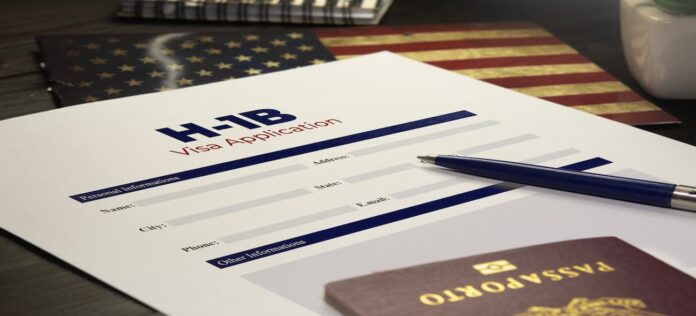
The Trump administration unveiled a new proposal Monday that would impose a $103,265 fee on H-1B visa petitions for foreign workers subject to the program’s annual statutory cap, months after a federal judge struck down the administration’s previous $100,000 fee.
Under the proposed rule issued by the Department of Homeland Security, the money would be used to cover federal expenses associated with operating the legal immigration system. Those costs include work performed by DHS as well as the Justice, State and Labor departments.
“The proposed H-1B fee is intended to recover the costs incurred across the federal government to adjudicate, vet, and support lawful immigration programs that otherwise must be funded by taxpayers,” U.S. Citizenship and Immigration Services spokesperson Zach Kahler said in a release.
The administration’s latest approach comes after a federal judge in June invalidated its earlier attempt to charge a $100,000 fee for H-1B applications.
U.S. District Judge Leo Sorokin concluded that the earlier policy amounted to an unlawful tax on visa applications, ruling that Congress alone possesses the legislative authority to establish immigration policy and impose taxes.
The administration’s previous proposal would have affected universities, hospitals and research institutions as well. Those employers, however, would be exempt from the newly proposed DHS fee.
David Bier of the Cato Institute questioned both the legality and practical impact of the administration’s latest proposal, arguing that describing the charge as a cost-recovery measure does not resolve the problems that doomed the earlier policy.
“The administration claims the new fee will be a ‘cost recovery mechanism,’ even though the first fee led to a nearly 90 percent reduction in filings and a $28 million loss in revenue. The government itself told the court that the $100,000 fee was ‘arguably prohibitive’ and ‘does not raise revenue,’” David Bier of the Cato Institute said in a statement sent to The Hill.
Bier further argued that immigration fees are legally limited to recovering costs associated with processing immigration and naturalization matters. He also noted that employers would be required to pay the massive fee when filing a petition without knowing whether the application would ultimately be approved.
“Even if it did raise revenue, that would not make it legal because immigration fees can only be imposed to recover the costs of adjudication and naturalization services. And because this is a filing fee, employers would have to pay it with no guarantee that USCIS [U.S. Citizenship and Immigration Services] will approve the petition. Almost no one will risk more than $100,000 with no guarantee of approval,” Bier added.
Federal law generally allows 85,000 new H-1B visas each year. That figure consists of the standard 65,000-visa cap along with another 20,000 visas reserved for applicants who earned a master’s degree or higher from an American college or university. Of the regular 65,000 visas, 6,800 are specifically allocated to citizens of Chile and Singapore.
The H-1B program has become a particularly contentious issue within the technology sector, where companies frequently rely on the visas to employ foreign workers in specialized occupations requiring advanced skills.
Computer-related jobs account for nearly two-thirds of H-1B approvals, according to the Bipartisan Policy Center, with software engineering, data science and information technology support among the fields heavily represented in the program.
Companies, technology workers and other interested parties will have 30 days to submit comments on the proposed rule once it is formally published in the Federal Register, which officials said is expected to occur Tuesday.
{Matzav.com}