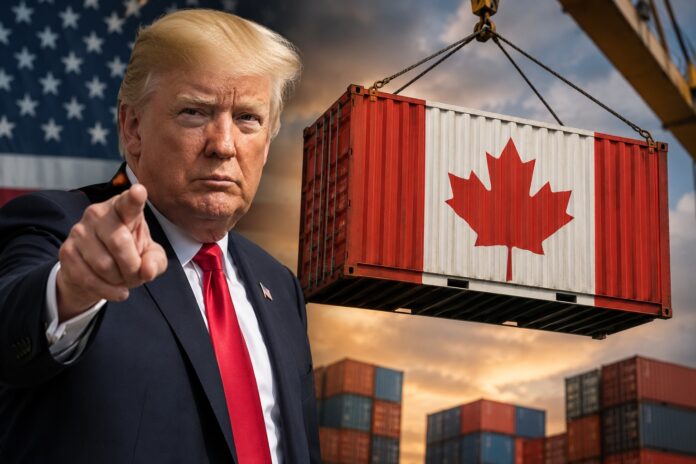
President Donald Trump’s 50% tariff on roughly $20 billion worth of Canadian imports took effect early today after eleventh-hour negotiations between Washington and Ottawa broke down, setting the stage for a new trade confrontation as Canada vowed to retaliate dollar for dollar.
The sweeping levy applies to an array of Canadian products entering the United States, including wine, hockey sticks and cement, after the two countries failed to finalize an agreement before the deadline.
US Trade Representative Jamieson Greer blamed Canada for the collapse, saying Ottawa backed away from understandings that had been reached only days earlier.
“Tonight, Canada declined to finalize the trade deal under the terms agreed earlier this week, despite the US offer to Canada to receive the best treatment of any major exporter to our market,” Greer told reporters.
“New demands and walk backs of other commitments by Canada have upended the careful balance reached in the past days,” he added.
The new 50% tariff covers approximately $20 billion in Canadian goods, though energy products and certain essential imports, including fish and critical minerals, will be exempted.
Canadian Prime Minister Mark Carney responded to the breakdown by promising that Ottawa would strike back against the new American tariffs.
“Canada will match those tariffs dollar for dollar to protect our workers and businesses,” he said in a statement.
“In the coming days, the government will introduce additional measures to support Canadian workers and businesses, building on the nearly $25 billion in support provided over the past 18 months,” Carney added.
Trump had initially given the two sides until 12:01 a.m. Wednesday to reach an agreement and avoid the 50% levy. He subsequently extended the deadline until Saturday as negotiations appeared to make progress in their final stages.
Trump administration officials have said the tariffs are intended to address Canada’s “substantial retaliation” and “discrimination” against American products and businesses.
Carney, however, portrayed the dispute as part of a broader transformation in Washington’s approach toward international trade, including its economic relationships with longstanding allies.
“We have recognised from the beginning that America has changed, and that we will not return to our old relationship,” Carney’ statement continued. “Our government understood, before many, that America is altering all its trade relationships. Putting tariffs on its closest allies and charging for access to its vast market.”
The Canadian prime minister blamed the failed negotiations on “last-minute changes in the US proposed terms” that he described as “unfair, uneconomic, and called into question the reliability of any deal”.
Only hours before the tariffs took effect, Trump had publicly expressed confidence that Washington and Ottawa would ultimately reach an agreement, citing his relationship with Carney.
“The deal with Canada is moving along and we should be able to have a deal,” Trump told reporters at Joint Base Andrews before departing for a rally in South Carolina.
Trump also revealed that his administration is “starting on a new deal with Mexico” while simultaneously negotiating with its northern neighbor.
“I only make good deals. Much better deal for the United States, both with Canada and Mexico,” Trump declared.
The 50% tariff was first announced last month, shortly after Trump and Carney were seen speaking with one another at the World Cup final in New Jersey.
The two leaders continued their discussions this week, speaking by telephone Monday afternoon as officials attempted to hammer out an agreement.
″We are negotiating,” Carney said of talks with Trump. “The negotiations are very intense and delicate. This is not the time to talk about negotiations in public.”
One of Washington’s objectives during the talks was reportedly to persuade Canada to withdraw retaliatory actions imposed in response to Trump’s earlier tariffs. Those Canadian measures included restrictions on American liquor and tariffs targeting US automobiles.
When Trump announced Wednesday that he was extending the deadline by three days, he also raised the possibility that a trade agreement could include a revival of the long-stalled Keystone XL pipeline project.
“The great Keystone XL Pipeline, long ago killed by Sleepy Joe Biden, may be awoken from the grave!” the president wrote on Truth Social.
Canada, meanwhile, had been pressing Washington for significant reductions in American tariffs affecting some of its most important industries.
Ottawa sought to have the US tariff on Canadian-made automobiles reduced from 25% to 15%, while also pushing for tariffs on Canadian steel and aluminum to be cut in half, from 50% to 25%.
Even late Friday, Canadian officials were publicly insisting that negotiations remained alive.
“We have more work to do. We are going to continue working up until the last minute. Our job is not finished,” Canada’s Minister of Internal Trade Dominic LeBlanc said as he left Greer’s office approximately four hours before the deadline.
LeBlanc’s office also communicated with Carney’s US economic advisory team earlier Friday, describing the negotiations as “complex and consequential.”
“I want to be direct with you about where we stand. This is an intense moment. The stakes are significant… That pressure is being felt by Canadians across the country, and those at the table are acutely aware of it,” the email read.
The stakes are particularly significant because of the enormous volume of commerce flowing between the neighboring countries. Canada is the United States’ second-largest trading partner, and nearly 72% of Canadian goods exports went to the American market last year.
At the same time, the United States recorded a $46.4 billion goods trade deficit with Canada in 2025, according to the Office of the US Trade Representative.
The latest confrontation comes after Trump imposed broad double-digit tariffs on imports from nearly every country last year, after declaring America’s trade deficit a national emergency.
In February, the Supreme Court struck down Trump’s so-called “Liberation Day” tariffs, ruling that the International Emergency Economic Powers Act did not give the president authority to impose the sweeping duties.
For the new Canadian tariffs, the Trump administration has instead turned to Section 338 of the Tariff Act of 1930, a Great Depression-era provision that has never previously been invoked.
Section 338 permits the president to impose tariffs as high as 50% on imports from countries deemed to have discriminated against American businesses. The provision does not require a trade investigation and places no specific time limit on how long such tariffs may remain in effect.
Trump has accused Canada of discriminating against American automobile, alcohol and cheese exports. Canada, along with China, was one of only two countries to impose retaliatory tariffs on the United States in response to Trump’s levies last year.
Greer warned last week that the administration would not allow retaliatory measures against American tariffs to go unanswered.
“If a country retaliates against us, we’re obviously not going to tolerate that,” Greer said. “We’ll take action. My sense is the Canadians, they want to have a more conciliatory approach, but we’ll see.”
{Matzav.com}