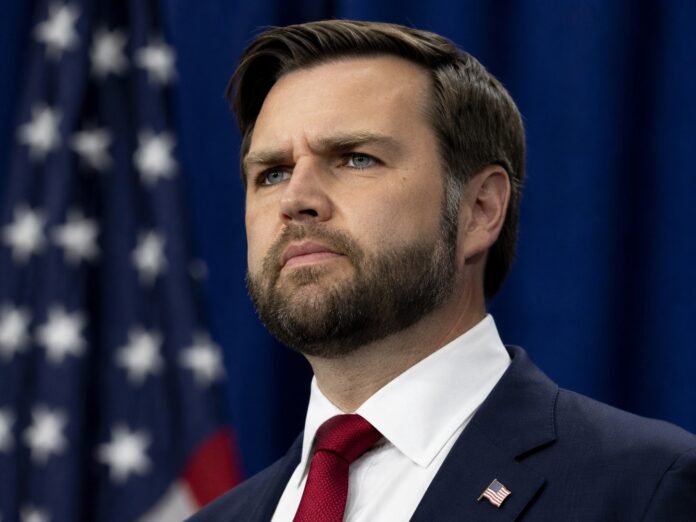
Vice President JD Vance said Thursday that Treasury Secretary Scott Bessent has developed a carefully structured strategy, backed by President Donald Trump, aimed at bringing the nation’s soaring $40 trillion debt under greater control by ensuring that economic growth ultimately outpaces the growth of federal debt.
During an appearance on Newsmax’s “Carl Higbie Frontline,” Vance said the administration’s approach has been deliberately pursued by Bessent and is already beginning to move the country in the desired direction.
“He [Bessent] has had a very discreet plan, of course, supported by the president of the United States, to get the United States to a point where our economy is growing faster than our debt,” Vance said on Newsmax’s “Carl Higbie Frontline.”
Vance acknowledged that the size of the debt remains a serious problem, while blaming the Biden administration for leaving the Trump administration with what he described as a fiscal “debt bomb.” He said the key to addressing the problem is generating economic expansion at a faster pace than the debt accumulates.
“And if you look, we are on track. So, even though the debt is too high, even though we inherited this debt bomb from the Biden administration, we actually do have a plan to get the economy growing faster than the debt and that’s the most important thing,” the vice president added.
Vance’s comments came the same day Bessent argued that robust economic growth can enable the United States to overcome its massive debt burden, which crossed the $40 trillion threshold on Wednesday.
“There’s nothing magic about the $40 trillion number, and we can grow our way out of that,” Bessent told “Squawk on the Street” co-host Sara Eisen on CNBC.
The Treasury secretary also pushed back against what he characterized as misleading claims surrounding the federal deficit and the deficit as a percentage of the nation’s gross domestic product.
“But what we do want to signal is I think there’s been a lot of misinformation in terms of what’s going on with the deficit, what’s going on with the deficit to GDP,” he added.
Bessent said part of the current debt picture reflects a temporary factor stemming from tariff refunds mandated by the Supreme Court after its February ruling against emergency tariffs imposed by Trump.
According to Bessent, U.S. Trade Representative Jamieson Greer intends to establish “the same level of tariffs,” which the Treasury secretary expects will leave “2026 tariff income is going to be roughly what it was in ’25.”
The $40 trillion debt milestone has renewed concerns on Capitol Hill, where lawmakers have increasingly warned about Washington’s inability to meaningfully confront a fiscal problem that has grown steadily more difficult to ignore.
Republicans have generally pointed to the scale of federal spending and the cost of entitlement programs as major drivers of the country’s mounting debt. Democrats, meanwhile, have argued for raising additional revenue from wealthy Americans and corporations while also pursuing changes to federal spending.