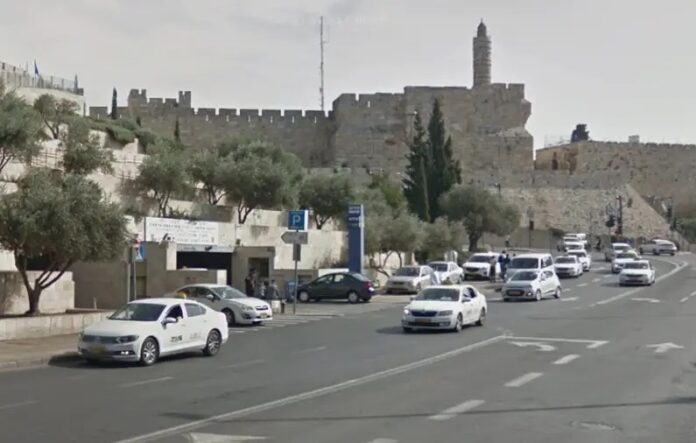
Drivers heading to the Kosel in Yerushalayim can find themselves paying as much as 150 shekels for just several hours of parking, even as another garage only a short distance away charges dramatically less, according to an investigation by Emess.
With parking scarce around the Old City and vehicle access to the Kosel restricted at various times, motorists arriving in private cars are left with relatively few choices. One common option is parking near Jaffa Gate and continuing to the Kosel either on foot or aboard Superbus minibuses serving the Old City. Yet two parking garages located near each other in that area can leave drivers with strikingly different bills.
One driver whose experience was reported to Emess parked in the Karta parking garage last Thursday at approximately 12:30 p.m. and left at around 5 p.m. He was charged 150 shekels.
A review of the operator’s published rates showed that the regular Thursday rate is 37 shekels per hour, with a daily maximum of 150 shekels. As a result, someone spending only several hours visiting the Old City can reach a three-digit parking bill.
The difference becomes particularly striking when compared with the nearby Mamilla parking garage. According to information obtained by Emess, another motorist who parked at Mamilla for approximately the same amount of time paid only about 50 shekels. Mamilla also has a daily maximum of approximately 70 shekels.
That means two people visiting the Kosel for roughly the same period of time could park within a short distance of one another and have one pay more than twice as much as the other.
Karta and Mamilla are situated close together along Yitzchak Kariv Street near Jaffa Gate. For a motorist coming from outside Yerushalayim who is unfamiliar with the local parking options, however, there may be little indication that choosing one entrance over the other could result in a difference of many dozens of shekels.
From the perspective of an unfamiliar visitor, the garages may appear to be two nearby parking facilities serving essentially the same heavily visited area. The difference may become apparent only when it is time to pay.
The situation is particularly noteworthy because the two neighboring garages have been at the center of a competition dispute stretching back more than a decade.
Karta, a company created by the Israeli government and the Yerushalayim municipality to develop the Mamilla area, was approximately 74% owned by the state and 26% by the municipality. After falling deeply into debt, the company entered a lengthy liquidation process beginning in 2006-2007, with its assets subsequently sold over the years.
It was only in 2025, nearly two decades after the liquidation process began, that a creditors’ arrangement was approved, bringing one of Israel’s longest and most complicated liquidation proceedings to an end.
The history of the Karta garage contains a notable irony. When the property was put up for sale, Alrov, controlled by Alfred Akirov, submitted the highest bid, offering 110 million shekels.
The Antitrust Authority, however, blocked Alrov from acquiring the garage because the company already controlled the nearby Mamilla and David Citadel parking facilities. Regulators were concerned that allowing a single entity to control all three garages could undermine competition in the Old City area.
Following that decision, Karta was sold to REIT 1, which had submitted the second-highest bid of 107 million shekels.
It did not take long for questions to arise about whether the regulatory decision had actually benefited consumers. In 2015, after Karta raised its parking rates, Akirov criticized the Antitrust Authority and argued that a decision intended to preserve competition had instead hurt motorists.
The current pricing disparity highlights that unusual outcome. Mamilla is connected to a commercial complex that naturally has an interest in attracting visitors and therefore maintains comparatively moderate parking rates. At Karta, meanwhile, a driver can reach the 150-shekel daily maximum within just a few hours.
Choosing the less expensive garage, however, is not always possible.
Mamilla operates during limited hours, meaning that motorists arriving when the garage is closed — particularly early in the morning — may have fewer available alternatives. Karta, by contrast, operates around the clock.
For observant Jews, there is an additional concern: the Karta garage also operates on Shabbos. Central Park, the company that operates the garage, states on its website that Karta is open “24 hours” on “Shabbat and holidays,” and even publishes a separate pricing schedule for Shabbos.
As a result, an observant Jew traveling to daven at the Kosel may discover that one of the limited available parking options carries particularly high rates while being operated by a business that openly remains in operation on Shabbos.
The larger question raised by the investigation is how motorists trying to reach the Kosel can end up paying 150 shekels for only several hours of parking when a considerably cheaper garage is located nearby but is not available at all hours.
With enormous demand, a severe shortage of parking and relatively few convenient alternatives surrounding the Old City, the significant difference between the two garages has prompted questions about the pricing structure and the practical level of competition available to motorists.
Central Park defended Karta’s pricing in a statement to Emess, saying customers who use its app receive substantial discounts and arguing that its dynamic pricing system helps ensure that spaces remain available to more visitors.
“Users of the Central Park app enjoy significant discounts compared to the regular price list. On the Thursday in question, the maximum daily rate on the app was NIS 120. The Karta parking lot operates on a dynamic pricing model, which is intended, among other things, to make parking available to a large number of visitors to the Old City and Western Wall area. Significantly lower pricing would result in a small number of vehicles occupying parking spaces for many hours without allowing turnover. It should be noted that only a small portion of customers actually reach the maximum daily rate, while most customers pay less, depending on the duration of parking and the rate in effect when they enter the parking lot.”
The Yerushalayim municipality and Israel Competition Authority did not provide responses to Emess.
{Matzav.com}