Iran says it will establish a new “prohibited zone” near the Strait of Hormuz, threatening to sanction vessels that enter the designated area as Tehran faces mounting American military and economic pressure and worsening economic conditions at home.
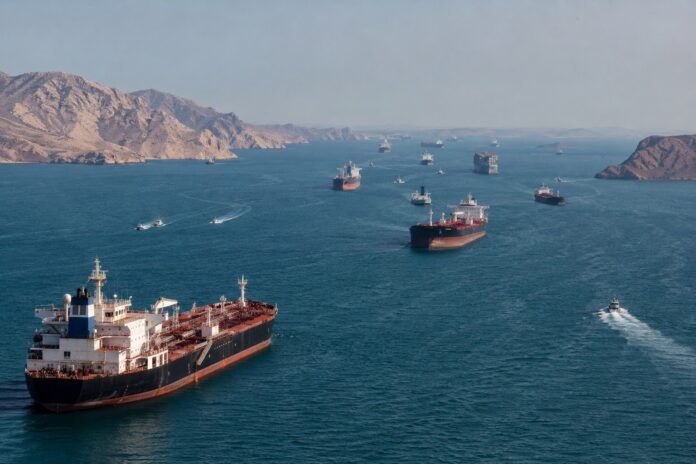
Mohsen Rezaei, Iran’s top security official, announced the planned maritime zone on Sunday, saying it would extend from what Tehran describes as the U.S. Navy’s blockade line into portions of the Persian Gulf.
“In the coming days, a prohibited zone will be announced outside the Strait of Hormuz. This zone will start from the US Navy’s blockade line and include areas of the Persian Gulf. Any ship entering this new zone will be placed on the sanctions list” of Iran, Rezaei told state television.
The announcement comes amid renewed tensions around the strategically critical Strait of Hormuz and escalating exchanges between American and Iranian forces. Shipping through the waterway has declined sharply, while oil prices have climbed amid concerns about continued disruptions to energy supplies.
At the same time, Tehran is moving to raise the price of gasoline for consumers who exceed the country’s lower fuel quotas, as the Iranian economy struggles under intensifying U.S. pressure.
Iran currently operates a three-tier gasoline pricing system. Consumers pay 1,500 tomans per liter for their first 60 liters each month and 3,000 tomans per liter for the following 50 liters. Consumption beyond those amounts has been priced at 5,000 tomans per liter. A toman, commonly used in Iran for everyday transactions, is equivalent to 10 Iranian rials.
Iranian government spokeswoman Fatemeh Mohajerani announced Sunday that the highest pricing tier will double to 10,000 tomans per liter, equivalent to approximately 4.5 U.S. cents, beginning Sept. 8.
“The rate will increase to 10,000 toman rials from the morning of September 8,” Mohajerani said in remarks carried by state media.
“Different numbers were mentioned in expert meetings but because the president had promised the people, the rate of 10,000 tomans was set,” she added.
Mohajerani subsequently stressed that the prices charged under the first two tiers of Iran’s gasoline system will not change.
The fuel increase comes as Iran’s currency continues to lose value. The rial was trading above 2.2 million to the U.S. dollar on the black market Sunday, compared with approximately 1.7 million rials to the dollar before the U.S.-Israel war against Iran began on Feb. 28. The currency had fallen to what was then a record low of approximately 1.8 million to the dollar in late April.
Iranian officials have acknowledged the severe economic problems facing the country while blaming U.S. sanctions and restrictions on oil exports for intensifying the pressure. Tehran has also established an “Economic War Headquarters” as it seeks to counter the impact of sanctions and other economic measures.
Washington, meanwhile, has stepped up its campaign against Tehran. The Treasury Department last week launched “Operation Economic Outcast,” an effort aimed at further isolating Iran economically and restricting revenues available to the Iranian regime.
The economic measures have unfolded alongside renewed American military operations against Iran. U.S. strikes resumed this past week, including attacks in areas around Qeshm Island, Chabahar and Bandar Abbas near the Strait of Hormuz.
The latest escalation has also spilled directly into maritime traffic. American and Iranian forces have targeted vessels in and around the strait, contributing to a sharp reduction in commercial shipping through one of the world’s most important energy corridors.
President Donald Trump further increased pressure on Tehran on Friday by warning that the United States could soon strike Pickaxe Mountain, a heavily fortified underground complex located near Iran’s damaged Natanz uranium enrichment facility.
Pickaxe Mountain contains two deeply buried tunnel complexes and has drawn increasing attention over concerns about Iran’s ability to rebuild portions of its nuclear infrastructure there. Iran maintains that its nuclear program is intended exclusively for peaceful purposes.
Trump reiterated from the Oval Office that the United States would not permit Tehran to acquire a nuclear weapon.
“Iran will not have a nuclear weapon,” he said, before adding, “We may hit Pickaxe very soon…if there was anything going on with Pickaxe.”
The threatened establishment of the new Iranian maritime zone adds another potential flashpoint around the Strait of Hormuz, where military confrontation, restrictions on commercial shipping and concerns over global oil supplies have already heightened tensions between Tehran and Washington.
{Matzav.com}