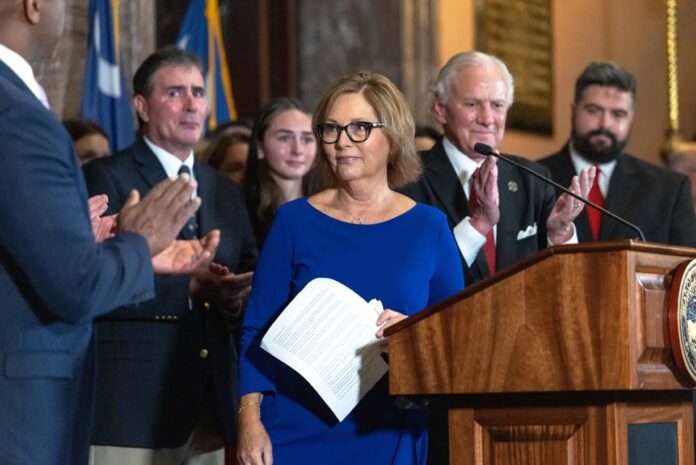
South Carolina Sen. Darline Graham has secured the Republican nomination for U.S. Senate, winning Tuesday’s special election runoff after receiving a high-profile endorsement from President Donald Trump, according to a race call by the Associated Press.
Graham, a political newcomer who was appointed to the Senate seat previously held by her late brother, Sen. Lindsey Graham, defeated Rep. Ralph Norman for the GOP nomination. She will now face Democratic nominee Annie Andrews, a pediatrician, in November’s general election in the heavily Republican state.
The runoff became necessary after none of the candidates captured enough support to win the Republican special election primary outright earlier this month.
Graham entered the race with Trump firmly behind her. Following Lindsey Graham’s death from a heart condition on July 11, South Carolina Gov. Henry McMaster appointed Darline Graham to fill the remainder of her brother’s term. Trump supported her appointment as the interim senator and subsequently endorsed her campaign for a full term.
Trump’s decision to throw his political weight behind Graham made the contest one of the more closely watched tests of his influence during this year’s midterm primary season, as he backed an inexperienced candidate against more established Republican figures.
Appearing at a Myrtle Beach rally on Aug. 21, Trump made clear that his support for Graham was also tied to his relationship with her brother.
“I’m doing this to honor Lindsey. That’s why I’m here,” Trump said. “So, Darline, we got to win that race.”
Graham, meanwhile, embraced both Trump’s endorsement and her own status as a newcomer to electoral politics.
“The critics say I shouldn’t run for the Senate. They say I’m not a politician. You know what I say? Guilty as charged,” she said during the rally. “By the way, President Trump has never served in elected office before and I think he’s done a damn good job.”
Trump’s super PAC, MAGA Inc., also provided substantial financial assistance, spending more than $827,000 in support of Graham. The group had largely stayed on the sidelines financially during several other competitive Republican primaries this election cycle.
Trump’s endorsements have produced mixed results in some of this year’s most closely watched contests, including defeats in races in Florida, Georgia, Iowa and Minnesota. Overall, however, Trump-backed candidates have recorded more primary victories than losses as the president continues to wield considerable influence among Republican voters.
Ray Saldi, 60, said he voted for Graham, although endorsements from political figures were not what ultimately persuaded him. Instead, he said, Graham’s family name and lack of a lengthy political record appealed to him.
“I really liked her brother, Lindsey Graham. I just wanted to make sure that she’s truly genuine to the people of South Carolina,” he said.
Saldi said he believed Graham would be more inclined to prioritize South Carolina’s interests in Washington.
Although Graham began the campaign without previous political experience, she stepped into an established political operation built during her brother’s decades in public office. Lindsey Graham had held elected office since 1995, beginning with his service in the U.S. House before moving to the Senate.
Speaking to supporters Monday in Aiken, South Carolina, Graham said she hoped to carry forward her brother’s work on behalf of the state.
“I want to continue to fight to finish what he was doing. He helped this state. He brought resources to this state. And you know what? If we don’t bring them here, they’re going to go somewhere else, right?”
Her limited experience nevertheless became an issue during the abbreviated runoff campaign. At the only candidate debate before Tuesday’s election, hosted by Newsmax, Graham faced criticism over her response to a question about the strategic importance of Taiwan and the South China Sea.
“I’m just going to be honest here,” she said. “I’m not that informed on national security.”
The remark drew boos from members of the audience and stood in sharp contrast to the political reputation of Lindsey Graham, who devoted much of his Senate career to foreign policy and national security matters and was known for advocating an assertive U.S. posture overseas.
Norman entered the race with significantly more political experience. A five-term congressman and member of the House Freedom Caucus, he had also sought the Republican nomination for South Carolina governor earlier this year, finishing third. During his brief Senate campaign, Norman repeatedly pointed to his record in elected office as an argument for sending him to the Senate.
Casting his ballot Tuesday, Norman acknowledged his uphill battle and portrayed himself as the underdog.
“I love being an underdog,” he said. “I think our people are going to get out and vote. I think they’re excited. The electricity that we’ve had has been great.”
Norman also had some appeal among Republicans who were less closely aligned with Trump. Although he has generally supported Trump’s political agenda, Norman backed his longtime friend, former South Carolina Gov. Nikki Haley, when she challenged Trump for the Republican presidential nomination in 2024.
Haley reciprocated during the Senate contest, with political action committees aligned with her pouring more than $700,000 in outside spending into efforts supporting Norman.
In the end, however, Graham’s lack of a traditional political résumé became an asset rather than a liability. At a time when voters in both parties have repeatedly shown an appetite for candidates who present themselves as outsiders, Graham leaned heavily into the argument that she was not a career politician — and Republican voters ultimately handed her the nomination.