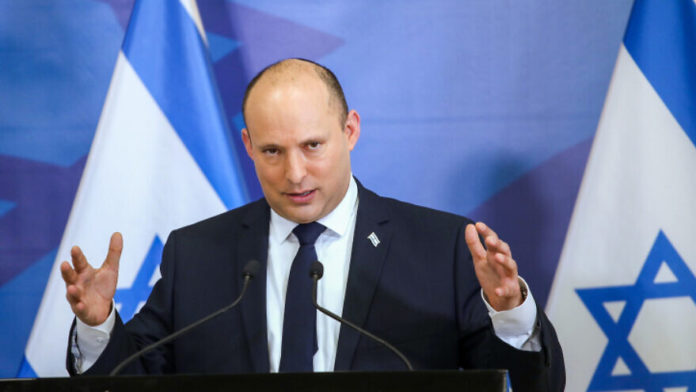
Internal Israeli security documents reportedly reveal that a new Qatari funding mechanism benefiting Hamas was approved in late 2021, months after then-Prime Minister Naftali Bennett publicly declared that the era of Qatari “suitcases of dollars” entering Gaza needed to end.
According to an investigative report aired Sunday evening by Israel’s Channel 13, confidential meeting summaries and security protocols show what the report described as a significant gap between the government’s public declarations and the policy being implemented behind the scenes regarding money reaching Hamas.
The investigation, conducted by journalist Michael Shemesh, reported that while Bennett publicly declared that “the suitcases of dollars are something we inherited and that needs to disappear from the world,” an alternative mechanism was approved as early as October 2021.
Under the arrangement, Qatar purchased approximately $10 million worth of fuel from Egypt each month. The fuel was then transferred into the Gaza Strip without Israeli supervision and delivered directly to Multi Trade, a company that the report said was owned by Hamas. According to the investigation, proceeds from the fuel sales were used by Hamas to pay the salaries of its employees.
At the center of the report are summaries of meetings between Maj. Gen. Ghassan Alian, then the Coordinator of Government Activities in the Territories, and Qatari envoy Mohammed al-Emadi, who was reportedly given the code name “The Jeweler” by Israeli security officials.
According to the documents, on October 17, 2021, “The Jeweler” informed Israeli officials that he had succeeded in developing an alternative mechanism for paying salaries to senior Hamas personnel.
Under the proposal, the funds would effectively be transferred through fuel purchases from Egypt: Qatar would spend $10 million to purchase Egyptian fuel, which would then be transferred without supervision directly to the Hamas-owned company. Hamas would subsequently be able to use either the proceeds generated from selling the fuel or the money it saved through the arrangement to cover salaries.
At the same time, the Qatari envoy asked Israel to increase the number of Gazans permitted to enter Israel for work to 30,000 per month.
“The Jeweler” subsequently met with Hamas leader Yahya Sinwar and later held discussions with Alian.
The investigation published an Israeli security assessment of the meeting between the Qatari envoy and Sinwar.
“The Jeweler describes a positive situation in the Gaza Strip, from both a security and civilian perspective, and the fuel-purchasing mechanism is agreed upon by all sides as a replacement for the grant for Hamas employees,” the document stated.
The newly disclosed documents reportedly contain several other significant revelations about Israel’s dealings with Hamas, Qatar and Egypt during that period.
One involved threats conveyed by Sinwar. According to the report, the Qatari envoy delivered a warning on Sinwar’s behalf that Israel should neither alter the status quo in Yerushalayim nor worsen conditions for security prisoners following the escape of Palestinian terrorists from Gilboa Prison.
COGAT responded in the protocol: “Israel governs its capital as a sovereign state.”
The documents also reveal that Israeli officials used the code name “the Greens” when referring to Hamas. According to the protocols, Qatari officials expressed a desire to reduce the dependence of “the Greens” on Qatari assistance for paying Hamas employees.
Another section of the documents addresses Israel’s policy of restraint along the Gaza border.
Despite ongoing efforts toward an arrangement with Hamas, the terror group reportedly continued provocations and established military positions just 100 meters from the border fence.
According to a summary of an October 2021 conversation, despite Israeli complaints over the activity, an Egyptian intelligence general instead chose to “thank the general for the restrained policy in the use of fire” by the IDF.
The report also highlighted the expansion of permits for Gazans to work inside Israel. At approximately the same time that the alternative funding mechanism was being approved and Qatar was pressing Israel on the issue, Israel significantly increased the number of Gazan workers allowed to enter the country, eventually reaching a quota of 30,000 per month.
Bennett’s office strongly rejected the report’s characterization of his government’s policies, arguing that he had fundamentally changed the previous system and adopted a significantly tougher approach toward Hamas.
“Former Prime Minister Bennett stopped the suitcases of dollars that entered the Gaza Strip indiscriminately; two-thirds of the money was transferred to food vouchers and reached civilians, and one-third was converted into fuel,” Bennett’s office said in response.
“Bennett led the change within a few short months, after years of complete abandonment. Bennett led a policy that was the opposite of Netanyahu’s — instead of surrendering to Hamas pressure and increasing the number of workers, Bennett permitted workers to enter only when the security situation allowed it.”
Bennett’s office also pointed to the 2022 Flag March as evidence of what it described as his tougher policy toward Hamas.
“Another example of this is that Bennett insisted that the 2022 Flag March take place along its original route, despite Hamas threats, as opposed to Netanyahu, who diverted the route of the Flag March in 2021 because he was afraid of Sinwar.”
The statement also flatly rejected the contention that Bennett’s government pursued a restrained policy in response to Hamas-instigated disturbances along the Gaza border.
“In addition, the claim that a restrained and accommodating policy was adopted surrounding the riots at the fence is a complete lie. Bennett led a policy of zero tolerance for incendiary balloons, rockets and approaches to the fence without a response, ended the bombing of sand dunes as was done during the Netanyahu era, acted to carry out strikes against high-quality targets, and led the quietest year the Gaza border communities had experienced in the previous 20 years.”