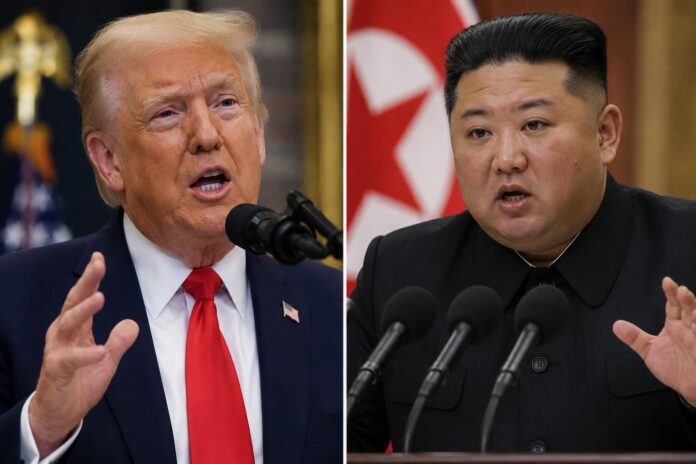
President Donald Trump said Sunday that the United States will reduce joint military exercises with South Korea, pointing both to his relationship with North Korean leader Kim Jong Un and Seoul’s refusal to assist Washington in its war against Iran.
Trump announced the move ahead of major U.S.-South Korean military drills that had been scheduled to begin Monday, arguing that the exercises are expensive for Washington and send an unnecessarily hostile message to Pyongyang.
“Based on my very good relationship with Kim Jong Un, of North Korea, I am not happy with the fact that the United States has, long ago, agreed to participate in Joint Military Exercises with South Korea. These exercises are not only costly, with much of these costs paid for by the United States of America (as usual!), but send a signal that is totally inappropriate and hostile, to a Country that, as long as Donald J. Trump has been President, has been unthreatening and respectful,” Trump wrote on Truth Social.
Trump then connected the issue to South Korea’s decision not to participate in U.S. efforts against Iran, though he acknowledged that the two matters were not necessarily directly related.
“While somewhat unrelated (?), I recently asked the President of South Korea if they would like to join us in the Denuclearization of the Islamic Republic of Iran, and they said, ‘No thanks!’” Trump wrote.
The president has repeatedly expressed frustration with American allies that have declined to provide assistance during the war with Iran, criticizing countries he believes have benefited from U.S. support while failing to reciprocate.
At the same time, Trump has continued to emphasize his unusually cordial relationship with Kim, despite decades of hostility between Washington and Pyongyang.
Earlier over the weekend, Trump posted a photograph of himself with the North Korean dictator and wrote: “Despite the unfriendly look on this particular picture, there are many where we’re smiling, Kim Jong Un and I get along GREAT!”
The U.S.-South Korean exercises, known as the Ulchi Freedom Shield drills, had been scheduled to begin Monday and continue for 10 days.
Pyongyang has repeatedly denounced military exercises conducted by the United States and its regional allies, portraying them as preparations for an attack on North Korea. Last year, North Korea’s Central Military Commission described trilateral exercises involving the United States, Japan and South Korea as “the most comprehensive and offensive war drill for aggression in terms of scale, content and nature” conducted on the southern Korean Peninsula.
Trump’s latest decision follows a pattern established during his first term, when Washington and Seoul reduced the scale of some joint military activities as Trump pursued diplomacy with Kim and attempted to lower tensions on the peninsula.
In 2018, amid nuclear negotiations between the United States and North Korea, Trump argued that it was “inappropriate to have war games” on the Korean Peninsula.
The following year, after Trump and Kim failed to reach an agreement during their summit in Hanoi, Washington and Seoul announced that the large annual military exercises that had long been central to their defense partnership would be reorganized into smaller drills.
Trump also focused at the time on what he said was the disproportionate financial burden being carried by Washington.
“The reason I do not want military drills with South Korea is to save hundreds of millions of dollars for the U.S. for which we are not reimbursed,” he posted in 2019.
South Korea has been one of Washington’s closest Asian allies for more than seven decades, and its armed forces routinely train alongside American troops. The country is also home to Camp Humphreys, the largest U.S. military installation overseas, where thousands of American servicemembers, their families and South Korean nationals are based.
Trump, who met Kim several times during his first term, has continued to speak positively about their personal relationship since returning to the White House.
While traveling home from China in May, Trump said he had been communicating with Kim but declined to disclose how many conversations had taken place between the two leaders.
Kim, meanwhile, has cited the U.S. war against Iran as further justification for North Korea’s refusal to abandon its nuclear arsenal.
In remarks to North Korea’s Supreme People’s Assembly that were published in March, Kim accused Washington of “acts of state sponsored terrorism and aggression,” though he did not specifically name Iran.
{Matzav.com}