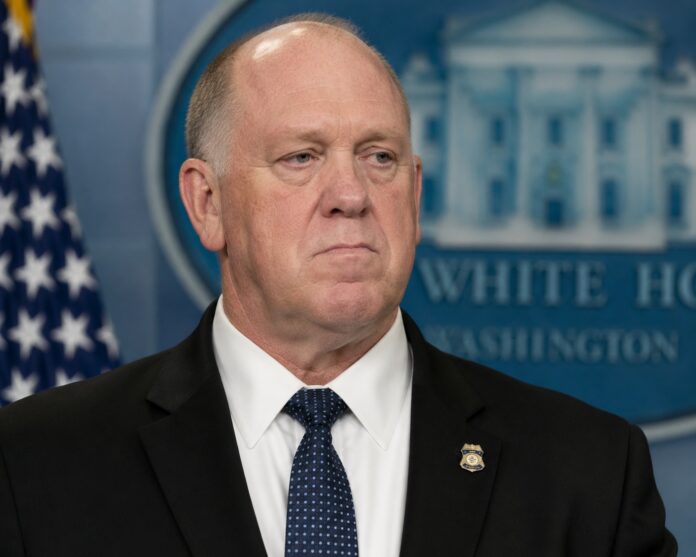
White House border czar Tom Homan said Sunday that federal immigration agents will pursue illegal immigrants wherever necessary, stressing that criminals and national security threats will find “no safe harbor” as the Trump administration expands immigration enforcement efforts across the country.
“President Trump is the president of the United States because he promised to enforce immigration law, and that’s exactly what we’re doing,” Homan said on CNN’s “State of the Union.”
“We’re sending a message to the world: The borders are no longer open. You can’t come here for a free pass and expect to stay forever,” he added.
During the interview, Homan mounted a broad defense of President Donald Trump’s deportation policies, addressing controversies involving arrests near school bus stops, the deportation of Haitians who have lost Temporary Protected Status, and accusations that ICE officers mistreated individuals being deported.
One issue involved reports from Connecticut that ICE agents arrested parents in the vicinity of school bus stops. Sen. Chris Murphy, D-Conn., has accused immigration authorities of targeting parents who were waiting with their children in Danbury.
Homan said he had not been informed about the specific incidents but pledged to raise the matter with the Department of Homeland Security.
“ICE is out there to enforce the law against those that have been ordered removed by a federal judge,” Homan said. “And especially if they’re a criminal or if they’re a national security threat, there’s no safe harbor for them in this country. We’ll go where we need to go.”
Homan pushed back against claims that ICE agents were deliberately attempting to intimidate children, describing those allegations as political rhetoric that has helped fuel threats against federal immigration personnel.
The border czar also defended the administration’s decision to deport Haitians after their Temporary Protected Status was terminated, despite the violence and instability that continue to plague Haiti.
“They lost their TPS status. They’re ordered removed. They got to go home,” Homan said. “They have no status here anymore. They can’t stay here.”
Pressed on whether he was comfortable with people being sent back to Haiti in light of the country’s dangerous security conditions, Homan said he was not familiar with the current situation there but insisted that ICE has an obligation to carry out lawful removal orders.
“The bottom line is they’ve been ordered removed,” he said. “The judge has made a decision. They must go home.”
Homan also discussed Sunday the deportation of Milo Yiannopoulos, the British right-wing provocateur and Trump supporter who was taken into custody Thursday and deported to the United Kingdom the next day.
According to Homan, his understanding of the case was that Yiannopoulos had remained in the United States beyond the expiration of his visa, failed to appear for immigration court proceedings, and subsequently was ordered deported by a judge.
“He had his due process, ordered removed by a federal judge, and ICE removed him. It’s that simple,” Homan said.
Homan rejected suggestions that Yiannopoulos received special treatment because he was removed from the country only a day after his arrest. He said the Department of Homeland Security has been working more broadly to reduce the amount of time individuals spend in detention and to carry out deportation orders more rapidly.
The interview also touched on a New York Times report alleging that deportees who resisted leaving a U.S. deportation flight after it arrived in Liberia were subjected to abusive treatment. Homan said he did not believe the alleged conduct had taken place, while emphasizing that the accusations would nevertheless be investigated.
“We use minimum force required to make a detainee comply,” Homan said. “If someone acted out of line, it would be investigated by internal affairs.”
Homan additionally renewed his support for outfitting ICE field officers with body cameras, although he said he could not verify whether the agency had achieved its goal of providing cameras to every officer by the end of August.
“I’m a big proponent of cameras because I want the American people to see what the officer sees when he makes a decision,” Homan said.
Homan said the rollout of the cameras was underway but acknowledged that he did not know whether implementation had been completed across the agency.
“Are they 100% deployed today? I’m not sure,” he said.
{Matzav.com}