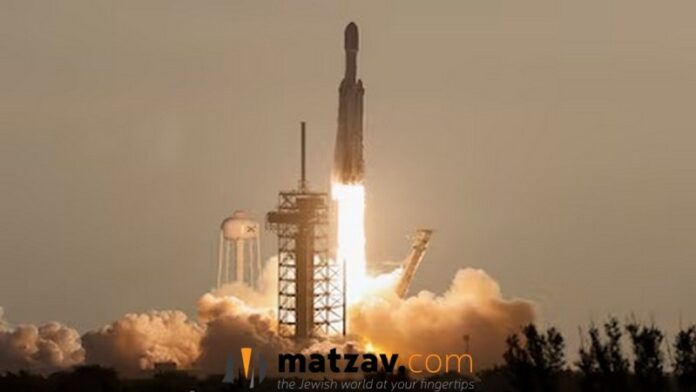
NASA’s newest major space observatory began its journey Sunday, launching on an ambitious mission to discover distant planets, investigate the mysterious forces shaping the universe and survey billions of galaxies and stars at unprecedented speed.
The $4.3 billion Nancy Grace Roman Space Telescope lifted off shortly after sunrise from Kennedy Space Center aboard a SpaceX Falcon Heavy rocket. Its destination is an observation point approximately 1 million miles from Earth, where it will operate in the same region of space as NASA’s James Webb Space Telescope.
Roughly the size of a bus, Roman is named for Nancy Grace Roman, NASA’s first chief astronomer. The spacecraft is expected to spend more than three months traveling to its observation point before beginning a sweeping examination of portions of the universe that scientists have struggled to study in detail.
“It’s going to find thousands of supernovae, tens of thousands of planets, billions of galaxies and tens of billions of stars,” said NASA science mission director Nicky Fox. “It’s going to be able to do things that we’ve never been able to do before with its massive field of view.”
Roman’s enormous viewing area is one of the features that sets it apart from NASA’s other flagship observatories. Its field of view is more than 100 times wider than that of the Hubble Space Telescope, which continues producing remarkable images after 36 years in orbit.
The Webb telescope, meanwhile, offers an even narrower but extraordinarily precise view, allowing scientists to closely examine extremely distant objects dating back nearly to the Big Bang.
Scientists plan to use Roman, Hubble and Webb in complementary roles. Their observations will also be combined with findings from the European Space Agency’s Euclid spacecraft and the National Science Foundation’s Vera C. Rubin Observatory in Chile as researchers pursue answers to some of astronomy’s most enduring questions.
Among Roman’s major assignments will be searching distant galaxies for stars surrounded by planets. After Roman identifies promising worlds, Webb’s greater sensitivity and power can be directed toward those targets for closer examination.
“Roman’s vast reach will allow us to find the weird, the rare and the unusual,” senior project scientist Julie McEnery said ahead of the launch. “We’ll redefine what it means to find a needle in a haystack.”
The mission is also expected to provide scientists with important new information about dark matter and dark energy, two mysterious components believed to account for most of the universe despite remaining largely invisible and poorly understood.
By creating an enormous catalog of galaxies, Roman will allow researchers to study the expansion of the universe and better understand the role these unseen forces play in determining its structure and evolution.
One of Roman’s greatest advantages will be the speed with which it can conduct its surveys.
According to McEnery, Roman can accomplish in approximately one month a survey of the Milky Way that would require Hubble roughly a century to complete. Scientists expect the telescope to rapidly scan the dense galactic bulge at the center of the Milky Way, producing an exceptionally deep view into the heart of our galaxy.
Roman is equipped with a wide-field infrared camera offering sensitivity comparable to Hubble while operating about 1,000 times faster.
It also carries an experimental coronagraph designed to block the overwhelming light coming from distant stars. By artificially creating an eclipse-like effect, the instrument could allow Roman to directly photograph faint planets orbiting stars that would otherwise obscure them from view.
NASA engineers have also designed Roman with the possibility of extending its operating life. The telescope can be refueled, meaning a robotic servicing spacecraft developed during the next decade could potentially replenish its fuel and keep it operating longer.
The mission reached the launch pad nearly a year ahead of schedule and remained within its budget. Roman also becomes the first NASA space telescope named for a woman.
Retired NASA scientist Ed Weiler said the recognition is particularly appropriate. Weiler, whom Roman hired in 1978, dubbed her the “Mother of Hubble” because of the crucial role she played in advancing the concept of placing observatories above Earth’s atmosphere.
Roman joined the newly established NASA in 1959 and became a forceful advocate for space-based astronomy, arguing that telescopes operating beyond the atmosphere could observe the universe with far greater clarity and reach. She died in 2018 at the age of 93.
“This is very, very fitting. I think Nancy would be very proud” that the telescope carrying her name will investigate fundamental mysteries including dark energy, Weiler said.
Roman’s primary mirror measures nearly 8 feet in diameter, approximately the same size as Hubble’s. Unlike a mirror originally manufactured specifically for a NASA telescope, however, Roman’s was once surplus hardware from a U.S. spy satellite program.
The National Reconnaissance Office donated two unused mirrors to NASA more than a decade ago so they could be repurposed for scientific missions. One ultimately became the heart of the Roman Space Telescope, while the second remains in storage.
{Matzav.com}