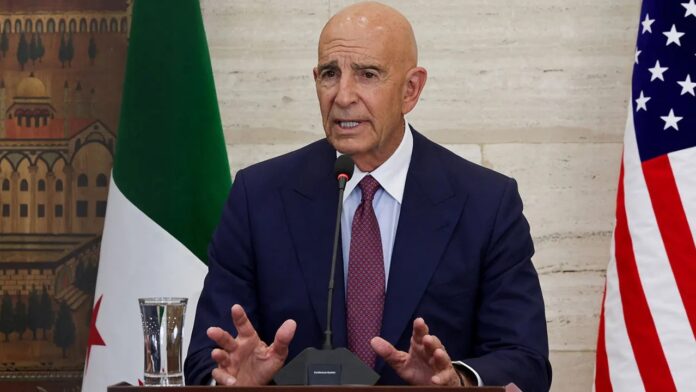
U.S. Ambassador to Turkey Tom Barrack has unleashed a political firestorm after suggesting that Israel may have intentionally tried to provoke Turkey with its recent strike in Syria and warning that the operation could have set off a chain of events leading to ”World War III.”
Barrack’s remarks quickly drew condemnation from several prominent allies of President Donald Trump, some of whom accused the ambassador, who also serves as Trump’s special envoy for Syria, of effectively taking Ankara’s side while departing from established U.S. policy.
Critics also pointed to what they described as a glaring disparity in Barrack’s comments: While sharply questioning Israel’s military actions inside Syria, he offered no similar criticism of Turkey’s extensive and longstanding military intervention there, including Ankara’s deployment of thousands of troops and establishment of military positions across northern Syria.
Barrack made his remarks during a lengthy interview Friday with X podcaster Mario Nawfal following Israel’s Tuesday strike on the Abu al-Duhur air base in Syria’s Idlib province.
Nawfal characterized the episode in dramatic terms while introducing his account of the interview.
”ISRAEL ALMOST STARTED A WAR WITH TURKEY, AND NO ONE, NOT EVEN TRUMP, SAW IT COMING,” Nawfal wrote on X.
”Israel’s strike in Syria almost started a war with Turkey,” he added, saying Trump’s special envoy had given him ”an extraordinary account of how it happened.”
Barrack then laid out several possible explanations for Israel’s decision, while emphasizing that he was discussing theories rather than presenting a definitive intelligence conclusion.
”Let me give you the postulated theories,” Barrack told Nawfal.
One possibility, he said, was that Israel intentionally sought to trigger a Turkish reaction.
”The first one is that the Israelis were baiting the Turks,” Barrack said.
Barrack pointed to Turkey’s 2015 downing of a Russian Su-24 near the Turkish-Syrian frontier, suggesting that Israel’s latest action created the potential for another dangerous confrontation involving military aircraft.
”Very dangerous game, having jets deployed on the border without notification, without some agreement,” Barrack said.
He also floated the possibility that domestic Israeli politics played a role in the decision, with Israel’s Oct. 27 elections approaching.
”One theory is they were just baiting Türkiye — that it’s a very aggressive, but maybe a well-received, pre-election concept,” Barrack said.
During his own commentary surrounding the interview, Nawfal indicated that he viewed the deliberate-provocation theory as the more plausible of the explanations Barrack presented.
Israel, however, has provided a dramatically different explanation for the strike.
Prime Minister Benjamin Netanyahu has said the Abu al-Duhur air base was attacked because Turkey was preparing to establish a military foothold there that Israel believed could pose a threat to its security.
Barrack disputed that version of events.
”There’s some intelligence that Israel had some intelligence that one of three things happened,” Barrack told Nawfal.
”Either there were Turkish military or military assets on site. We know that was not the case.”
According to Barrack, Israeli officials informed Washington of their concerns approximately six days before the attack, prompting U.S. officials to examine the intelligence.
”We all did our due diligence. We went back to our respective intelligence agencies,” he said.
”The answers we got were, ‘No, that’s not happening.’”
Syrian officials, however, have acknowledged that a Turkish delegation visited Abu al-Duhur just one day before Israel struck the facility, with the delegation reportedly inspecting reconstruction work taking place at the base.
Barrack said Turkey received no advance warning before Israeli aircraft approached the area. He argued that the lack of notification created an extremely volatile situation because Turkish military officials could detect Israeli aircraft approaching their border without knowing what the planes intended to do.
”The Turkish military is strong, they’re courageous, they’re very well equipped, they know what they’re doing,” Barrack told Nawfal.
Barrack said Turkish commanders could conceivably have responded: ”We’re going to have to scramble our own.”
Nawfal then asked whether a confrontation of that nature could potentially have escalated into a third world war.
”Could this be World War III?” Barrack responded. ”I think our opinion is anything could be World War III from an unintended act.”
At the same time, Barrack stressed that neither government appeared to actually desire a military confrontation between Israel and Turkey.
”Thank goodness, calm heads really came to the moment of the day, and we unwrapped it,” Barrack said.
Israeli Defense Minister Israel Katz responded forcefully Saturday, rejecting Barrack’s description of events as ”full of inaccuracies.”
According to Katz, Israeli intelligence clearly showed that Turkey intended to operate from Abu al-Duhur, and the IDF had recommended on several occasions that the facility be attacked.
Israeli officials have also said that Syria received a warning before the operation and that relevant information was conveyed to U.S. authorities.
”Erdoğan was caught with his hand in the cookie jar and was forced to retreat,” Katz said, referring to Turkish President Recep Tayyip Erdoğan.
Katz also dismissed Barrack’s suggestion that Netanyahu’s decision may have been influenced by Israel’s approaching election.
Barrack raised another potential explanation for the incident, suggesting that the operation might have resulted from a breakdown in communications among different branches of the Israeli security establishment.
”The other theory is that between the IDF, the Mossad, and the Prime Minister’s Office there was a miscommunication,” he said.
Barrack said such a breakdown would be particularly notable because the head of Mossad had recently participated in what he described as a productive two-hour discussion with Syrian Foreign Minister Asaad al-Shaibani.
During the interview, Barrack repeatedly emphasized what he described as Turkey’s restraint in dealing with Israel and the Syrian situation.
”I know that the Turks — their intelligence agency, their hierarchy, their foreign minister, the president, the head of intelligence — all are concentrating on restraint,” Barrack said.
”That’s a fact. They’re not predatory.”
”They’re not interested in attacking or even engaging in any kind of kinetic or adversarial relationship with Israel,” he added.
Barrack also recounted an exchange in which Trump questioned Erdoğan about why Turkey had not simply taken control of Syria.
”In public, Trump has asked President Erdoğan, ‘Why didn’t you just take Syria? If you were instrumental in helping them, why didn’t you just take it?’” Barrack said.
According to Barrack, Erdoğan replied: ”Because we don’t want it. We want Syria to be a sovereign and independent country.”
Barrack endorsed that portrayal, saying Turkey’s objective is ”a sovereign and independent Syria.”
Critics noted, however, that Turkey itself has repeatedly deployed military forces across the Syrian border.
Ankara launched Operation Euphrates Shield in 2016, Operation Olive Branch in 2018 and Operation Peace Spring in 2019, sending Turkish troops and Turkish-backed forces into Syria and establishing control over substantial portions of the country’s north.
Turkey continues to maintain thousands of military personnel inside Syria, along with military bases and observation posts across sections of the northern part of the country.
Ankara has defended those operations as necessary to combat Kurdish militants and terrorist groups and to protect Turkey’s southern frontier.
The Assad government, before its fall, repeatedly characterized Turkey’s presence as an illegal occupation and demanded the withdrawal of Turkish troops.
The U.S. State Department has also documented allegations from the United Nations, Amnesty International and Human Rights Watch that Turkish forces and Turkish-backed groups were responsible for civilian casualties, attacks on civilian infrastructure, looting and property seizures during Operation Peace Spring.
Turkey has denied those allegations.
Barrack did not offer a comparable criticism of Turkey’s military activities inside Syria during his conversation with Nawfal, instead directing his strongest criticism toward Israel’s actions.
The ambassador also sparked controversy by addressing Israel’s sovereignty over the Golan Heights.
”They still occupy the Golan against the U.N. resolutions, against all of the international order, which has said the Golan is Syria’s,” Barrack said.
That statement conflicts with the position adopted by Trump in 2019, when the president formally recognized Israeli sovereignty over the Golan Heights, reversing decades of U.S. policy.
Katz highlighted that contradiction in his response to Barrack, pointing out that the president Barrack represents formally recognized the territory as part of Israel.
Barrack’s overall characterization of the dispute therefore drew scrutiny from critics who noted the stark contrast in his descriptions of the two countries. He portrayed Turkey as restrained and ”not predatory,” while suggesting Israel may have been ”baiting” Ankara, playing a ”very dangerous game,” possibly acting for domestic electoral considerations and risking an escalation that could conceivably have produced ”World War III.”
Syndicated radio host Mark Levin responded by calling for Trump to remove Barrack from his post.
Sharing Barrack’s interview with Nawfal, Levin said the ambassador was ”crazy as hell” and added that he is ”Erdogan’s mouthpiece and lapdog and needs to be pulled.”
Political commentator Emily Shrader similarly criticized Barrack for appearing to contradict the Trump administration’s official recognition of Israeli sovereignty over the Golan Heights.
”Why is the U.S. Ambassador to Turkey Tom Barrack advocating directly against the policy of the United States and the policy of the president whom he serves?” she asked.
Shrader concluded, ”This guy needs to be fired immediately.”
Barrack’s favorable posture toward Erdoğan has previously drawn criticism from conservatives in Washington, particularly amid complaints about Turkey’s conduct toward Israel and its refusal to support the United States during the conflict with Iran.
Former Republican Sen. Rick Santorum has accused Barrack of having ”betrayed [the Kurds], Christians in Syria and our country for Turkey.”
”His behavior is a disgrace,” Santorum said. ”He should be recalled.”
Barrack also faced criticism in April from the Foundation for Defense of Democracies, where Turkey expert Sinan Ciddi and Jonathan Schanzer published an analysis titled, ”America’s Ambassador to Turkey Is Undermining U.S. Interests.”
The authors criticized Barrack for declaring that ”Turkey is not a country to be messed with” while placing responsibility on Israel for tensions with Ankara.
They also accused the ambassador of failing to confront Turkey over its ongoing relationship with Hamas and Ankara’s activities inside Syria.
”The job of the American ambassador to Turkey is not to make Ankara feel validated,” Ciddi and Schanzer wrote. ”It is to defend U.S. interests, uphold alliances, and confront a partner whose policies have repeatedly empowered America’s adversaries.”
For Israel, the dispute reflects a broader concern over Turkey’s expanding role in Syria. Turkey is a NATO member with one of the region’s largest militaries and has been steadily developing a substantial military presence inside Syria, raising Israeli concerns that Turkish forces could eventually pose a direct security challenge.
Barrack’s remarks have consequently fueled a larger debate over what critics see as an inconsistency in his approach: questioning the dangers and legitimacy of Israeli military intervention inside Syria while offering no comparable condemnation of Turkey’s considerably larger and longer-running military presence there.
{Matzav.com}