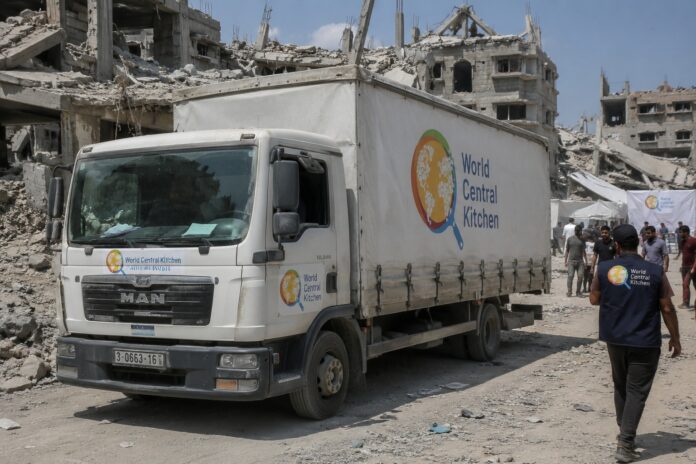
Britain, Canada and Australia issued a sharp joint condemnation of Israel on Friday over the IDF’s decision not to pursue criminal investigations into the 2024 Gaza strike that killed seven World Central Kitchen aid workers, calling the outcome “shameful” and demanding greater accountability for the deadly incident.
The seven WCK workers killed in the strike included three British citizens, an Australian, a Polish national, a dual American-Canadian citizen and a Palestinian Arab. Their convoy was struck by an Israeli drone after the aid workers had overseen the delivery and unloading of humanitarian supplies in Gaza.
The IDF on Wednesday released the findings of its General Staff Fact-Finding and Assessment Mechanism, which examined the circumstances surrounding the attack. Investigators concluded that Israeli forces had incorrectly assessed that Hamas terrorists had taken control of the WCK convoy.
According to the military’s findings, troops spotted an individual they believed to be armed aboard a truck traveling as part of the convoy. The positioning and movement of additional vehicles were also interpreted by troops, based on their operational experience, as indications that Hamas had taken control of the convoy.
World Central Kitchen had arranged for armed security personnel to accompany the humanitarian mission. However, according to the IDF investigation, the presence of those security personnel had not been coordinated with the Israeli military.
After the aid was unloaded at a warehouse, Israeli troops mistakenly identified several individuals as armed. The vehicles subsequently traveled south using a route different from the one that had been coordinated with the IDF. Operating under the erroneous belief that Hamas members were inside the vehicles, Israeli forces launched the strikes.
Investigators also found that Israeli personnel attempted unsuccessfully to reach WCK representatives during the roughly 30-minute period in which the convoy was being monitored.
Despite identifying serious operational failures that contributed to the mistaken identification and subsequent attack, the Chief Military Prosecutor determined that there was no reasonable suspicion that criminal misconduct had occurred. As a result, no criminal investigation will be opened and no further measures will be taken beyond disciplinary steps already imposed.
That conclusion prompted an unusually forceful response from Britain, Canada and Australia, whose governments have pressed Israel for accountability since the incident occurred.
“In the more than two years since, we have been pressing for Israel to swiftly and thoroughly consider the case and hold those responsible to account.” the three nations said.
“The announcement by the IDF on 19 August 2026 that it would not pursue criminal investigations into this strike, without further explanation, is shameful,” it said.
The three governments also criticized the timing of Israel’s announcement, which coincided with World Humanitarian Day.
“Announcing this decision on World Humanitarian Day, while the world honoured the courage and sacrifice of humanitarians, was particularly egregious,” the joint statement added.
The statement came two days after Australian Foreign Minister Penny Wong separately denounced the Israeli decision, saying she was “outraged” by the outcome of the military review.
Wong said Israel’s decision “falls far short of the accountability we expect” and announced that the Israeli ambassador to Australia would be summoned to discuss the matter.
Following the deadly strike in 2024, then-IDF Chief of Staff Herzi Halevi said that the WCK workers had been killed because of a mistaken identification and stressed that Israeli forces had not deliberately targeted the humanitarian organization or its personnel.
The IDF subsequently took disciplinary action against several officers over the incident, dismissing two officers and formally reprimanding senior commanders after its initial investigation identified serious failures in the military’s handling of the convoy.
World Central Kitchen halted its food distribution activities in Gaza in the immediate aftermath of the strike. The humanitarian organization resumed its operations in the territory approximately one month later.