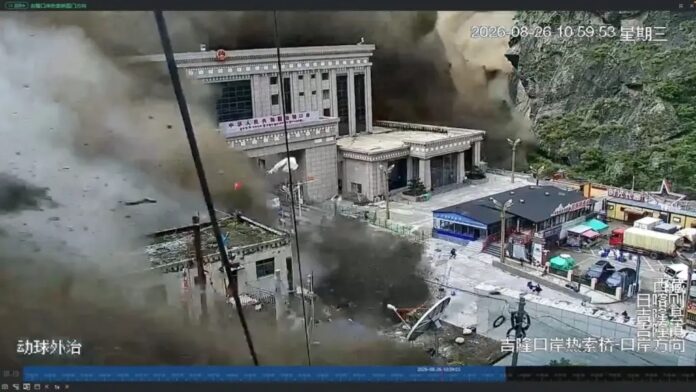
Catastrophic flash flooding along the Nepal-Tibet border killed nearly 100 people Wednesday and left hundreds missing, including at least 54 Americans, after a massive torrent of mud, rocks and water thundered down from the Himalayas and devastated communities in its path.
At least 98 people were reported dead on the Nepali side of the border, while more than 300 tourists remained unaccounted for. Officials said 54 Americans were among those missing as rescue crews scrambled to reach areas cut off by the destruction.
The disaster is believed to have begun when an enormous mass of rock and mud crashed into a river near the Himalayan frontier separating Nepal from Chinese-controlled Tibet, triggering a sudden and devastating surge downstream.
Terrifying footage from the region showed a towering wall of muddy water and debris racing through a valley as people fled desperately ahead of it. Buildings, roads and other structures were swallowed or swept away within moments.
Chinese leader Xi Jinping ordered an “all-out” search operation as authorities on the Tibetan side reported widespread devastation. Chinese state media said at least three people had been confirmed dead in the landslide and 265 remained missing, while officials described “significant” casualties in Gyirong, near Tibet’s border with Nepal.
Nepalese Foreign Minister Shisir Khanal told parliament Wednesday that preliminary information indicated the flooding could have been caused by an avalanche set off by an earthquake.
The United States Geological Survey initially reported detecting a magnitude 4.4 earthquake around the same time that surveillance footage captured the disaster unfolding along the border.
Hours later, however, the USGS said the seismic activity had not been an earthquake at all. Instead, the massive landslide itself had caused the shaking, producing seismic activity equivalent to a magnitude 5.2 earthquake.
The resulting torrent tore through communities in Nepal, destroying homes, businesses and roads as it raced downstream. On the Tibetan side, officials warned of “major casualties” as emergency teams searched through the devastated area, according to local media reports.
Authorities also issued flood warnings for heavily populated regions farther downstream, including areas of the northern Indian states of Uttar Pradesh and Bihar, amid fears that the effects of the disaster could spread beyond Nepal and Tibet.
Nepal’s tourism board said at least 391 foreign nationals were missing from the affected region. In addition to the 54 Americans, those unaccounted for included 142 Indian nationals who had been making a pilgrimage to Mount Kailash in Tibet, 34 Australians, 33 British citizens and 24 Canadians.
South Korea’s Foreign Ministry reported that at least nine South Korean citizens were also missing. All nine were employees of two energy companies involved in construction of a hydroelectric facility along Nepal’s Trishuli River.
The US Embassy said it was “deeply saddened” by the mounting death toll and advised Americans in affected areas to stay away from low-lying terrain, move to higher ground and comply with instructions issued by local authorities.
“We extend our sincere condolences to the families and loved ones of those who lost their lives, and our thoughts are with all those affected by this disaster,” the embassy posted on X.
The State Department also confirmed that it was following developments involving US citizens caught up in the catastrophe.
A State Department spokesperson said the agency “is aware of Americans impacted by floods in Nepal and is closely tracking the situation.”
The spokesperson did not provide further information about how many Americans were missing or whether any had been located or injured.
As the scale of the disaster became clearer, foreign governments and international relief organizations began mobilizing emergency assistance for Nepal and other affected areas.
India announced that it was dispatching 10 metric tons of humanitarian aid along with “essential medicines,” according to External Affairs Minister Subrahmanyam Jaishankar.
The International Federation of Red Cross and Red Crescent Societies also announced plans to provide emergency funding to the Nepal Red Cross as relief and rescue operations intensified.
European Commission President Ursula von der Leyen said Europe was preparing to assist with the international response.
“My thoughts are with all those affected, especially the families who have lost loved ones or are still waiting for news. We also share a thought for the brave first responders,” she wrote on X.
“We stand ready to mobilise further European assistance,” she added, saying the European Union’s Copernicus satellite service had been “activated to help map the affected areas in Nepal and support the response on the ground.”
{Matzav.com}